Based on your input, suggestions are offered below the "Search" button.
No suggestions
IdealPlanet: preserve the environment
Edenred aims to protect the environment by reducing its carbon footprint, consumption of resources and waste, designing eco-services for mobility and food waste and managing the impact of its solutions during their lifetime – with a strong commitment: achieving Net Zero Carbon by 2050, in line with the SBTi (Science Based Targets initiative1) methodology. In 2024, by obtaining SBTi's approval of its targets, Edenred joins over 5,000 companies pioneering this approach.
Reducing our carbon footprint and the consumption of energy, natural resources and waste
Convinced that action by the private sector is crucial to meet the target set by the Paris Agreement, Edenred announced in 2022 its ambition to achieve Net Zero Carbon by 2050, as part of its Beyond22-25 strategic plan.
On this occasion, the Group also strengthened its "Ideal" CSR policy by formalizing key performance indicators, accompanied by quantifiable targets with two milestones in 2030 and 2050, approved by SBTi in 2024.
Edenred is committed to:
Reduce absolute scope 1 and 2 greenhouse gas (GHG) emissions 51.4% by 2030, and 90% by 2050, from a 2019 base year;
Reduce its scope 3 greenhouse gas emissions 55% per million euros value added by 2030 and 97% per million euros value added by 2050, from a 2019 base year.
In order to achieve these targets, Edenred has put in place a concrete plan to reduce its carbon emissions that covers:
Optimizing the energy consumption of buildings and using renewables wherever possible. The Group's subsidiaries are encouraged to relocate to more responsible buildings and to measure and monitor their energy consumption. They are also encouraged to switch to renewable electricity contracts wherever possible. In 2025, the share of renewable electricity consumption across Edenred's sites reached 70%, representing an increase of 32 percentage points compared to 2024.
The launch of a new policy on company vehicles. The aim of this policy is to electrify Edenred's vehicle fleet and to encourage the adoption of more climate-friendly fuel options, depending on the possibilities in each local context. In 2025, the share of electric vehicles in car orders reached 37%. Meanwhile, 20% of the fleet runs on biofuels.
The reduction of the environmental footprint of IT equipment and servers. To do this, Edenred has an increased usage of virtual servers and seeks to constantly optimize the use of energy. Edenred is also putting in place an action plan to gradually extend the lifespan of the equipment made available to its employees.
The introduction of a sustainable procurement policy and the elaboration of an ethics charter for its suppliers to encourage them to adopt more sustainable measures.
October 2024: SBTi approves Edenred's 2030 and 2050 carbon emission reduction targets
The Group's solutions encourages new forms of sustainable mobility.
Conserving resources and managing the impact of solutions during their lifetime
For many years, the Group has had an ambitious approach to conserving resources and reducing waste as part of its Ideal CSR strategy. Since one of Edenred’s impacts on the environment stems from the commercialization of paper vouchers and plastic cards, the Group increasingly develops paper- and plastic-less formats for its payment solutions available to employee users. Taking an eco-design approach to these solutions, whether physical or digital, is one of the key aims of Edenred’s environmental policy. This approach helps limit waste production related to its solutions throughout their life cycle.
The Group carries out Life Cycle Assessment (LCA) studies in certain countries to assess the environmental impact of its products. First carried out in 2017 and then updated in 2022, the primary conclusion was that the plastic card has a lower environmental impact than paper Meal Vouchers. It also confirmed the positive impact of Edenred’s digitalization strategy, with the switch from paper vouchers to cards likely to reduce emissions by between 65% and 80%.
When paper cannot be replaced, subsidiaries are encouraged to use FSC (Forest Stewardship Council) and PEFC (Programme for Endorsement of Forest Certification) or recycled paper for the production of their tickets. In 2025, 16 subsidiaries (representing 98% of business volume in subsidiaries producing paper vouchers) used certified or recycled paper in the production of their vouchers, limiting Edenred's impact on the timber industry. In addition to these paper impact reduction measures, Edenred offsets 100% of GHG emissions linked to the issuance of paper vouchers annually through the purchase of carbon credits.
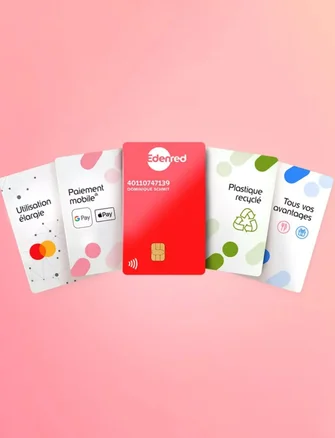
In addition, the Group was the first to set up a card collection and recycling system within its French subsidiary. When their card expires, the beneficiary receives a new one, along with the procedures for returning the old one to encourage recycling. The old card is ground by an Edenred partner using an entirely mechanical process , and the materials obtained (98% plastic, 2% metals) are used to manufacture new products.
↘ 31%
Reduction in absolute terms of Scope 1 and 2 GHG emissions compared to 2019
62%
of solutions ecodesigned
Designing eco-services
As a provider of specific-purpose solutions for food and mobility, the Group encourages the development of eco-services for sustainable mobility and the fight against food waste.
Edenred promotes sustainable transportation by developing innovative and low-carbon services. The Group encourages new forms of sustainable mobility by developing low-carbon services and solutions. In 2022, Edenred launched "Move for Good", a global sustainability program enabling its transport and mobility clients to mitigate their environmental impact. It is structured around 3 pillars:
Measure and reduce emissions through the switch to less carbon-intensive mobility options (such as electric of bioethanol vehicles).
Offset remaining emissions through carbon credit projects certified by third parties.
Sensibiliser à une mobilité plus respectueuse de l’environnement.
Edenred USA's Commuter Benefits solution allows American employees, since 2017, to use different means of transportation (bus, subway, bicycle) instead of their own car.
In France, Edenred has partnered with Betterway since 2022 to make sustainable mobility accessible. This partnership meets companies' growing expectations around managing employee mobility benefits, whilst boosting purchasing power by contributing to the cost of commuting between home and work.
Edenred also pays special attention to food waste as part of several initiatives.
In 2019, Edenred formed a new partnership in Chile with Karübag, a company that uses vermicomposting to treat and recover organic waste from offices, homes, restaurants and other places. Since its launch, over 36 of Edenred’s corporate clients have joined the Karübag initiative.
Framheim, a startup specialized in the fight against food waste, sent a questionnaire to some 180,000 Edenred partner restaurant owners in France to find out more about their anti-food waste practices and define their commitments. Since this 2018 survey, 400 establishments were awarded the label in 2019.
In Austria, Edenred launched a partnership with the organization Too Good To Go in April 2019 to encourage partners and employees in Edenred’s network to fight against food waste. Other Edenred countries, such as Spain, Portugal and Italy, also teamed up with the startup since 2021.
Finally, the Edenred Eco solution, created in 2009 in Belgium, promotes environmentally-friendly products and services. It encourages more responsible purchasing across various areas: food, lifestyle, furniture and transport.
The Group's long-term commitments
2017
2025
2026
targets
2030
targets
2050
targets
GHG EMISSIONS •
% reduction intensity per m² from scopes 1 & 2 (vs 2013)
GHG EMISSIONS •
% reduction per m€ value added from scope 3 (vs 2019)
-
-
-
55%
97%
ECO-DESIGN •
% of eco-designed solutions
27%
62%
-
70% and net zero paper
-
ECO-SERVICES •
Number of
environmental-friendly
services
9
40
-
1 per country
-
1. The Science Based Targets initiative (SBTi) is a collaboration between CDP, the United Nations Global Compact, the World Resources Institute (WRI) and the World Wide Fund for Nature (WWF). SBTi defines and promotes best practice in science-based target setting and independently assesses companies' targets.
2. The target boundary includes land-related emissions and removals from bioenergy feedstocks.
Find out more on our CSR commitments
People: improve quality of life
Presentation of the People axis of Edenred's CSR policy and the actions taken to improve quality of life.






 0:25
0:25